When a high-net-worth older user first sees a milk-white
When a high-net-worth older user first sees a milk-white, sharply angular...
When a high-net-worth older user first sees a milk-white, sharply angular blood pressure monitor in a luxury living room, their first reaction is often not reassurance but resistance—that formal language silently declares this is a hospital room. Home healthcare design has long placed function above experience, turning health monitoring products that should be ubiquitous into foreign objects that disrupt home aesthetics. As the silver economy shifts from 'subsistence security' to 'quality development,' how to let health monitoring products dissolve into home spaces in the guise of invisible healthcare is becoming one of the most valuable questions in industrial design.
The Quality Shift in the Silver Economy
The Quality Shift in the Silver Economy Is Widening the Design Gap
According to 2025 data from Guanyan Report Network, China's silver economy market size will reach RMB 9 trillion that year, up about 12.5% year on year; data from the National Bureau of Statistics at the end of 2024 show that China's population aged 60 and above exceeded 300 million for the first time. At the same time, 83% of older people say they are willing to spend more than 40% of their assets on health, a figure that reflects a high-value-added market whose consumption level far exceeds outside expectations.
However, there is a clear mismatch between supply and demand. Current home healthcare design still largely remains within a functional-compensation logic—handrails, rounded corners, high-contrast colors, thickened buttons. This visual language, formed in the era of institutional elderly care, creates a strong patient label in home settings. Under China's '9073' elderly care framework (90% home, 7% community, 3% institutions), home is where the vast majority of older users live long term, not a temporary transitional care space. High-net-worth older users in first-tier cities demand a quality of life that no longer allows any intruder with a 'hospital feel' in the home.
This design gap is being sensed by perceptive market players. At the 2025 Shanghai International Elderly Care Expo, millimeter-wave radar devices drew widespread attention for their imperceptible care form design—their core competitiveness lies not only in technical precision, but in completely eliminating visible medical forms, allowing health monitoring to truly recede from view and blend into space. This is an early signal of the 'invisible healthcare' concept moving from idea to product.
Invisible Healthcare
Invisible Healthcare: Three Integration Paths for Home Healthcare Design
'Invisible healthcare' does not mean making products invisible; it means letting medical functions exist as home objects—a bedside table, a floor lamp, a decorative screen—carrying the logic of health monitoring while presenting the language of home aesthetics. In this direction, industrial design interventions focus mainly on three dimensions:
Form Dissolution
Form Dissolution: From Medical Device Language to Home Appliance Language
Traditional medical device form logic comes from clinical settings—resistant to disinfection, easy to identify, convenient for medical staff operation. But in home settings, most of these constraints no longer hold. Functional modules such as blood pressure monitoring, heart rate tracking, and fall detection can be fully integrated into the panel of a bedside table, the base of a bookshelf, or the bottom of a table lamp. The core task of form design is to make the product visually belong to the home appliance series rather than the medical device category. This requires designers to have not only functional design capabilities for medical products but also a formal sensibility for home aesthetics—the integration of two design languages is the real barrier in age-friendly industrial design.
Material Elevation
Material Elevation: Using Material Language to Signal Quality
Materials are the most direct carrier of a product's value tier. Most current home healthcare products use ABS engineering plastic, whose matte off-white appearance has long been strongly associated with cheap medical supplies. The breakthrough for high-end home healthcare design lies in introducing material systems common in consumer electronics or premium home goods—anodized aluminum alloy, matte black glass, soft fabric—materials that not only change the touch but fundamentally rewrite the quality narrative conveyed by the product. Once health monitoring product design breaks away from the material conventions of medical appearance, it meets the basic threshold for entering luxury home settings.
De-Medicalized Interaction
De-Medicalized Interaction: Screen-Free Design and Environmental Sensing Over Operational Interfaces
The display screen itself is one source of the medical feel. Numbers, waveforms, alarm lights—this visual system originates from the ICU and is naturally out of place in home spaces. The interaction logic of invisible healthcare is to detach data presentation from the device itself: monitoring continues in the background, abnormalities are pushed to the phone, and in normal conditions the device displays no numbers or indicator lights. Non-contact monitoring solutions based on millimeter-wave radar or optical sensors are moving this logic toward mass production—users need not wear anything or operate anything; the device embeds in space as an environmental sensing layer. This is the most complete form of integration between home healthcare design and smart home.
IDING DESIGN in Practice
IDING DESIGN in Practice: Medical-Grade Accuracy Drives a De-Labeled Appearance
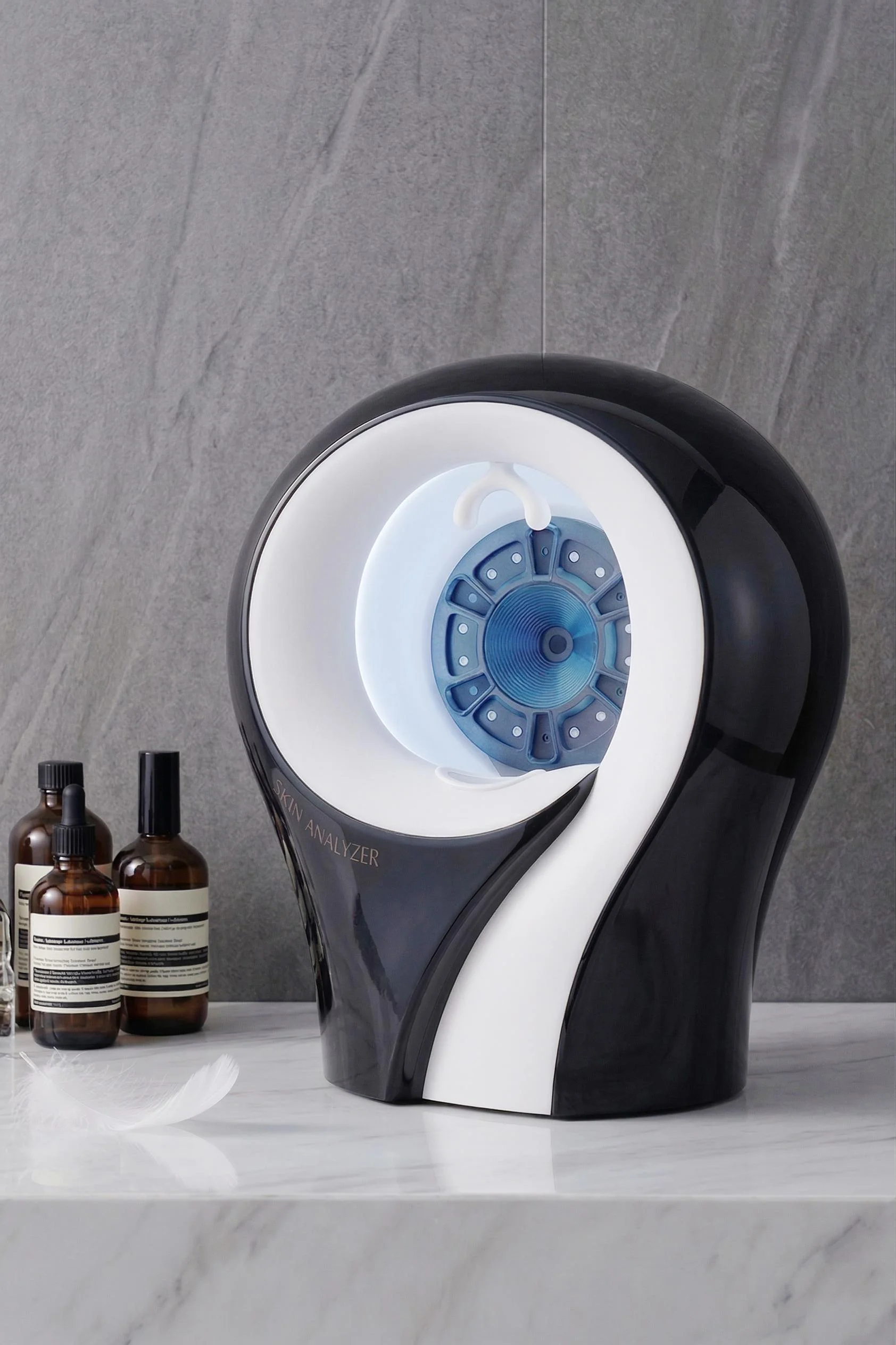
The core tension of this project was how to make the product not look like a medical instrument while ensuring medical-grade performance with detection accuracy ≥95%. The client's initial proposal followed the conventional form of dermatology diagnostic equipment—a square housing, ring light source, and digital display—with an overall form logic close to professional imaging equipment. The IDING DESIGN team proposed a form reconstruction design direction early on: biomimetic form and fluid sculpture: reconstructing the visual semantics of medical equipment.
Traditional medical or beauty testing devices often carry a cold, mechanical stereotype. This product makes a bold attempt in exterior design to reduce users' defensive mindset and increase trust.
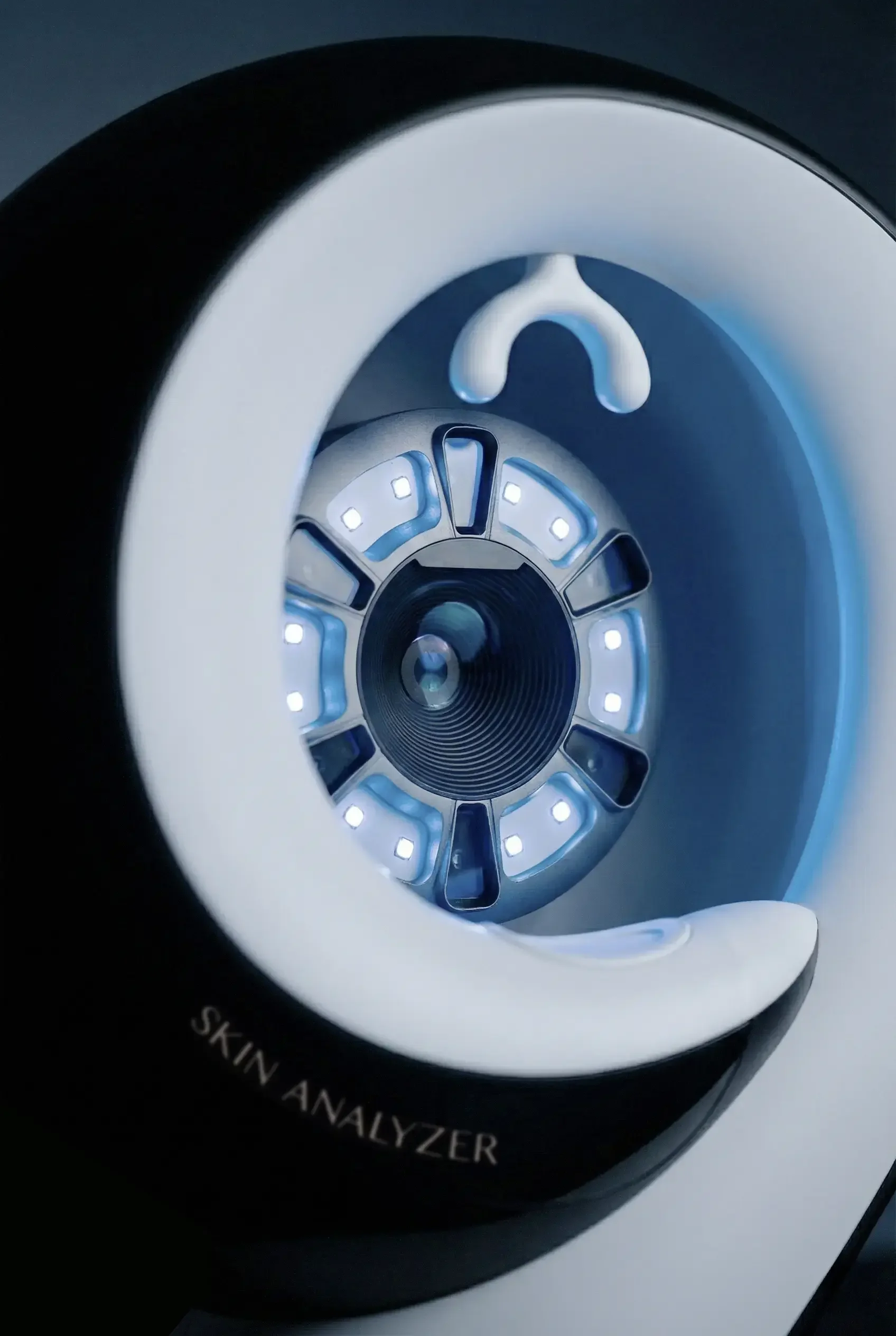
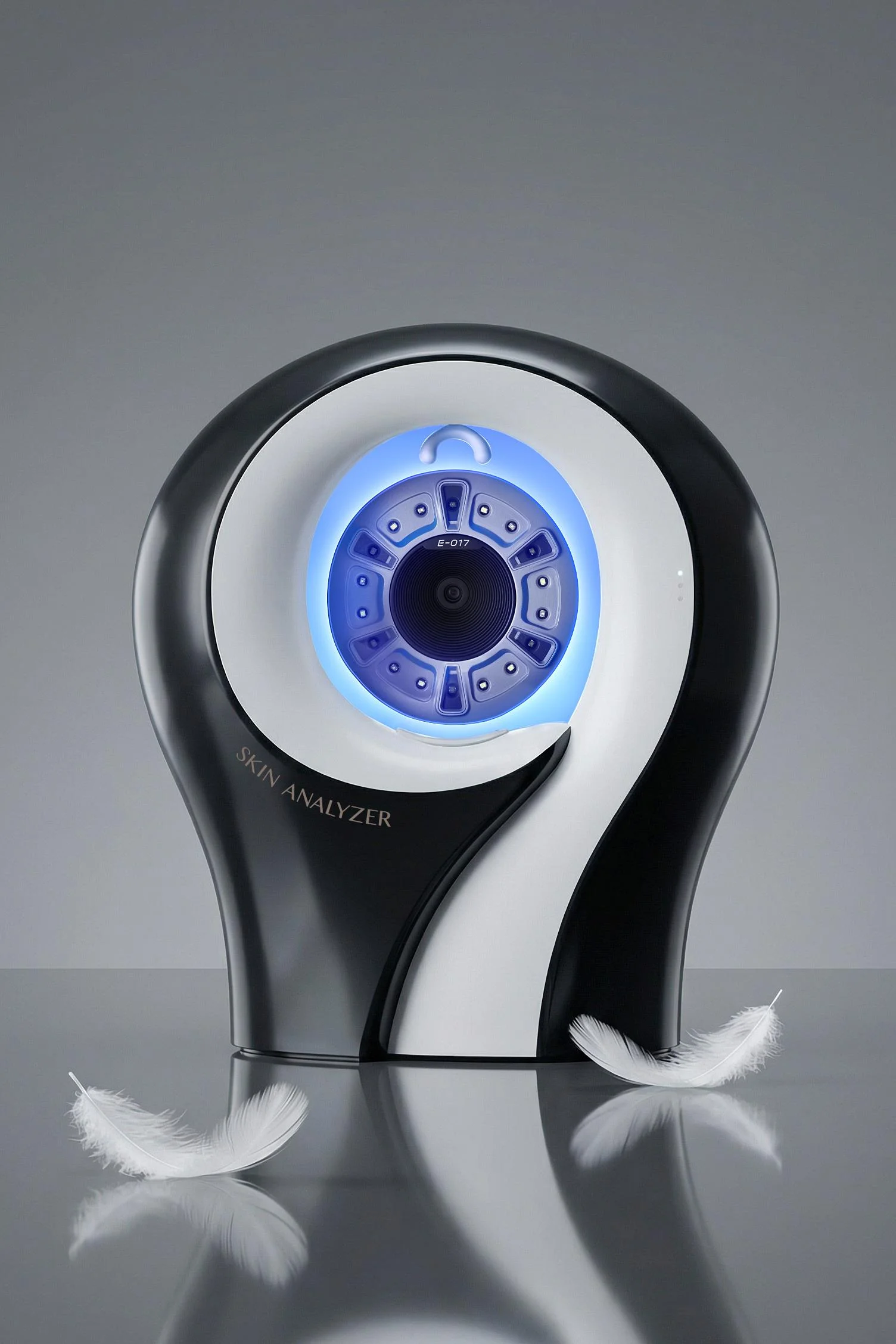
'Fluid sculpture' and a '9'-shaped silhouette: The product's overall side profile draws on the form of the numeral '9' and combines it with the conch curve in biomimetics, creating a smooth, coherent 'fluid sculpture' visual effect. This design is not only highly recognizable in space but also suggests the patterns of vitality and natural cycles.
CMF Design (color, material, and finish): The exterior uses a high-gloss black-and-white two-tone assembly. Black conveys mystery, professionalism, and a 'black tech' visual semantics, while the large white area combined with a ring of soft light creates a safe, pure, and hygienic clinical feel. The collision of the two colors visually reduces the product's bulk, making it easier to integrate into modern commercial beauty spaces. The material language of consumer electronics recalibrates the product's perceived value tier. The data display interface is completely detached to a mobile app; the device itself has no digital display, and the indicator system retains only a minimal ring status light. Verified by independent testing, while optimizing the exterior form, detection accuracy reaches ≥95%, and dual-scenario adaptation for mobile and desktop is achieved. The product enters mid-to-high-end beauty clinics and high-net-worth household user channels.
IDING DESIGN in Practice
IDING DESIGN in Practice: Medical-Grade Accuracy Drives a De-Labeled Appearance: The core value of this project lies in its validation of a...
The core value of this project lies in validating the feasibility of a design path: medical-grade accuracy and de-medicalized appearance...
Between them, there is no irreconcilable contradiction—what they need is simply an execution team with sufficient cross-disciplinary design fluency, and a project consensus that places 'form strategy' and 'technical parameters' side by side as design goals from the earliest stage.
Industry Perspective
Industry Perspective: The Design Entry Ticket to the High-End Aging-Friendly Market
China's silver economy is undergoing a shift in its value focus. According to a 2025 report by the China Service Trade Guide Network, the silver economy-related market is accelerating its transition from 'survival security-oriented' to 'quality development-oriented,' and the market size of cross-sector integration formats is expected to exceed RMB 15 trillion by 2030. In first-tier cities, high value-added formats such as smart health and wellness and high-end medical real estate have become development priorities, and this trend will continue to amplify demand for high-end home healthcare design.
Against this trend, competition in home healthcare design will gradually shift from 'technical parameters' to 'scenario narrative'—whoever establishes a design discourse system for invisible healthcare earlier will be more likely to take a first-mover position in the high-net-worth older-user market. Notably, this shift places higher demands on industrial design firms: experience only in medical device design, or only in consumer electronics design, is not enough to support form decisions for such products; what is truly scarce is the integrated execution capability to bridge the two design languages of healthcare and home.
The continued maturation of technologies such as millimeter-wave radar, optical sensors, and AI edge computing is also providing increasingly rich hardware carriers for invisible healthcare. It is foreseeable that within the next 3 to 5 years, the primary arena for health monitoring product design will shift from functional parameter validation to competition in form strategy and spatial integration capability. For companies aiming to enter the high-end aging-friendly market, now is the window to complete the building of a design language system.
Home Healthcare Design in the Longevity Era
Home Healthcare Design in the Longevity Era Is Not Merely a Product Beautification Issue, but a Question About '...
Home healthcare design in the longevity era is not merely a product beautification issue, but a systemic design proposition about 'how to let health monitoring coexist with a dignified life.' IDING DESIGN's ongoing practice in medical devices and consumer health products gives us a concrete rather than abstract judgment on this direction: invisible healthcare is achievable, provided it is incorporated into the design objective early enough
rather than doing 'appearance beautification' patch-up work after technical development is complete.
View IDING's Complete Case Library: Industrial Design Cases | Medical · Electronics · Robotics · AI Products | Chengdu IDING
Book a Design Assessment: Industrial Design Collaboration Consultation | Chengdu IDING Industrial Design
References
References: References
References
Guanyan Report Network, 2025 | In-Depth Research and Development Trend Forecast Report on the Current State of China's Silver Economy Industry (2025–2032) | Applicable section: Industry Status
National Bureau of Statistics, 2024 | Statistical Communiqué of the People's Republic of China on the 2024 National Economic and Social Development | Applicable section: Industry Status
Xinhuanet, 2025 | Silver Economy Accelerates Toward New Growth, Creating a Trillion-Yuan Market (2025 Shanghai Elderly Care Expo Report) | Applicable sections: Industry Status, Invisible Healthcare Trends
China Service Trade Guide Network
China Service Trade Guide Network, 2025 | Research Rep... on China's Silver Economy Cross-Sector Integration Business Formats: China Service Trade Guide Network, 2025 | Ch...
China Service Trade Guide Network, 2025 | Research Report on China's Silver Economy Cross-Sector Integration Business Formats | Applicable section: Industry Perspective
IDING DESIGN Official Website, 2025 | AI Smart Skin Detection Device / Positive-Pressure Air-Supply Respiratory Protection System / Repeating Hemostatic Forceps Case | Applicable section: IDING Cases