Author
Author: Luo Wanlan | Founder/Design Director, IDING DESIGN; Sichuan-Chongqing Top Ten Industrial Designer; …
Author: Luo Wanlan | Founder/Design Director, IDING DESIGN; Sichuan-Chongqing Top Ten Industrial Designer; 20 years of industrial design experience
The “Hidden Needs” of Industrial Equipment Design
The “Hidden Needs” of Industrial Equipment Design
The design constraints of equipment products are completely different from those of consumer electronics. The core of consumer products is “attracting attention,” while the core of industrial equipment is “fewer problems”—reliability in extreme environments, safety boundaries for operators, and the maintainability enabled by modularity. These are the design factors that truly affect product competitiveness.
One easily overlooked reality is that many design decisions in industrial equipment are “invisible.” The fin orientation of a heat sink, the 15-degree tilt angle of a control panel, the open/close silkscreen of a dust door—users will not notice them, but when they are missing or done wrong, the device's user experience deteriorates directly. This is precisely what distinguishes industrial equipment design from appearance styling: it solves systemic conflicts among function, process, human factors, and cost.
18 Cases
18 Cases: A Capability Map
IDING DESIGN's 18 industrial equipment design cases can be organized into a capability map by scenario dimension.
Aviation and Logistics
Aviation and Logistics
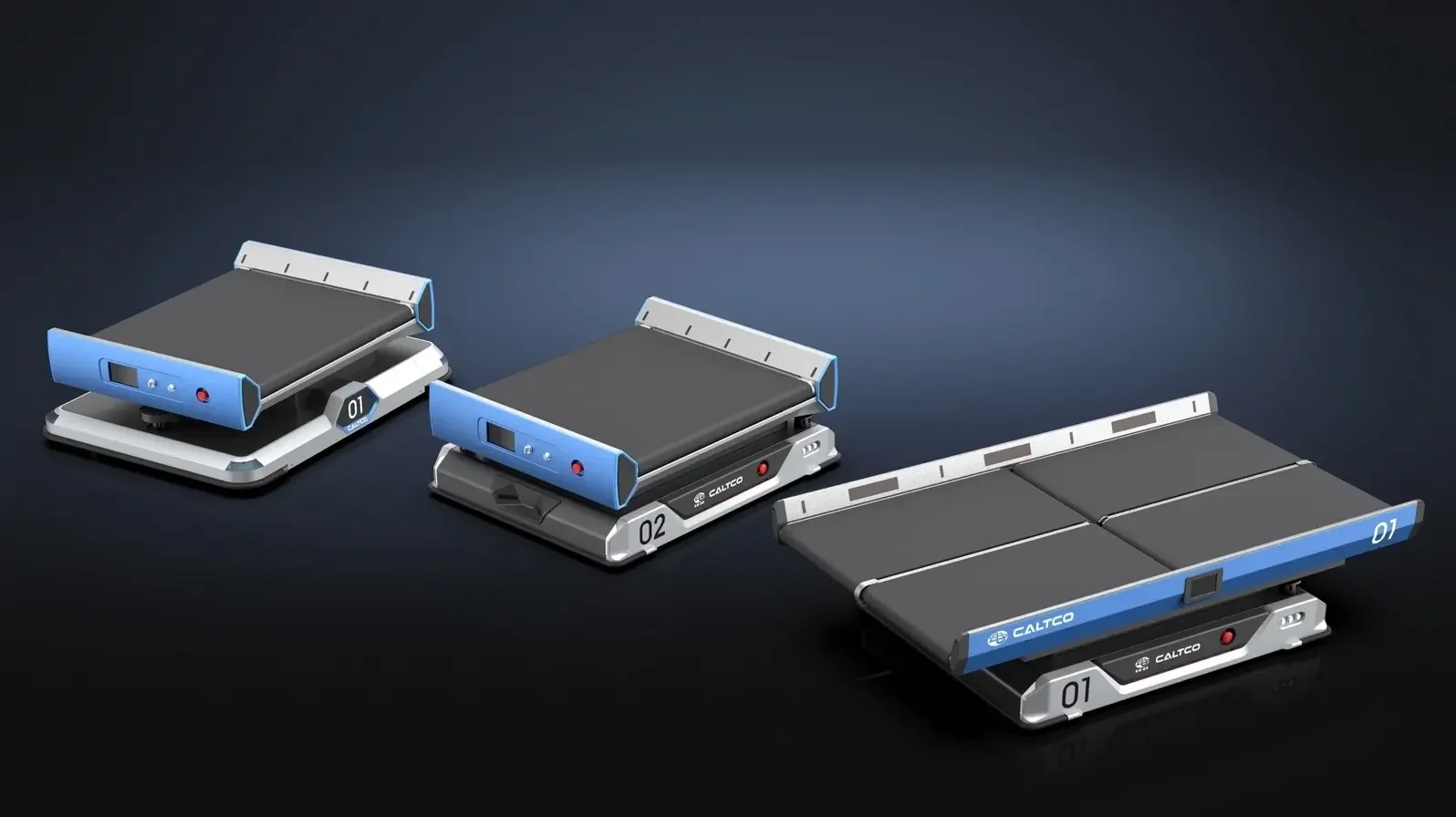
The AMR aviation logistics robot designed for China Civil Aviation is one of IDING DESIGN's most representative cases in industrial equipment design and won the iF Product Design Award. According to Interact Analysis's 2024 Global Mobile Robot Market Report, AMRs are moving from warehouses to public scenarios such as airports, introducing new dimensions for design requirements.
The airport baggage handling scenario imposes three constraints on equipment: first, with dense foot traffic, the equipment's exterior must reduce collision risk and maintain visual appropriateness in public spaces; second, once a terminal is built, it is difficult to add infrastructure, so the robot must be ready to use immediately; third, baggage transfer has strict positioning accuracy requirements, with errors measured in millimeters.
IDING DESIGN's solution unfolds along three dimensions. In appearance, a blue-silver minimalist contrast color scheme pairs with a streamlined body—blue echoes aviation's professional attributes, silver reinforces industrial precision, and rounded corners eliminate the “aggressive” visual language of traditional logistics equipment. In structure, modular design allows rapid deployment without any airport infrastructure modifications, and individual modules can be replaced during maintenance without affecting overall operation. In performance, 12-hour battery life combined with ±5 mm positioning accuracy moves baggage flow between terminal and apron from “manual cart pushing” to “autonomous dispatch.”
Unlike common logistics robots, this device does not operate in a back-end warehouse but works within travelers' line of sight. Its design must answer two questions at once: whether baggage can arrive on time, and—when it appears in the terminal, will it make people uncomfortable. The iF Award jury's evaluation points to the same logic: functional aesthetics is not “making the machine look good,” but making design part of scenario efficiency.
Exoskeleton
Exoskeleton
The Fushanshou Exoskeleton, developed in collaboration with the University of Electronic Science and Technology of China, is a passive lower-limb assist system. The design constraints are extremely clear: the structure must be compact enough for users to put on independently, the joint range of motion must match the human natural gait, and the overall weight cannot become a new burden. The final solution achieved a 1:6 load-bearing ratio through a six-curved-link mechanism and fits 90% of adult male body types.
Security and Special Equipment
Security and Special Equipment
From the DeepGlint Human Eye Camera to the drone jammer (Red Dot Award), from the China Institute for Radiation Protection's protective dosimeter to CGN's portable neutron detector, these products share a common trait: the operating environment determines everything. The drone jammer's three-antenna layout is not a styling choice but a functional requirement for frequency-band coverage; the neutron detector's handheld flip structure stems from the operating habits of nuclear power plant inspectors in different postures.
Energy and Communications
Energy and Communications
The hollow-design middle section of an LNG dispenser, the urban aesthetic integration of 5G communication optoelectronic equipment, and the cold-forged heat sink of an LED light engine—these cases share a common thread: industrial equipment is evolving from a “functional container” into a “scenario node.”
In addition, IDING DESIGN also covers scenarios including inspection robots, AC servo drives, motion controllers, optoelectronic equipment, and the E-Fating smart judicial terminal. The 18 cases span industries from nuclear power to courts, and from civil aviation to 5G base stations, but the underlying logic is consistent—the starting point of each project is not “what shape to draw,” but “what conflict to solve.”
Three Trend Judgments
Three Trend Judgments
As Forbes columnist Bernard Marr pointed out in 2025 regarding six major manufacturing trends, equipment manufacturing is undergoing a triple upgrade toward experiential, modular, and intelligent development—IDING DESIGN's 18 cases happen to sit at the intersection of these trends.
First, equipment products are undergoing a “consumer-grade experience upgrade.” When operators have developed muscle memory for iPhone interactions, rough industrial equipment panels become efficiency bottlenecks. The shield-element front housing of a servo drive and the 15-degree tilted operating surface of optoelectronic equipment—these are not “beautification”; they are an industrial translation of interaction logic.
Second, modular design is upgrading from a cost strategy to a competitiveness strategy. The battery quick-swap structure of inspection robots and the replaceable heat sink solution of AC servo drives are essentially using design to reduce the customer's total lifecycle cost—including procurement, maintenance, upgrade, and end-of-life.
Third, industrial equipment design firms need to understand both 'software' and 'hardware.' The Xiaoling Tongxue remote avatar robot integrates LiDAR and SLAM autonomous navigation, while 5G optoelectronic equipment requires understanding communication protocols. In the equipment sector, an industrial design firm's competitiveness increasingly depends on the depth of its understanding of underlying technologies, not on drafting speed.
Choosing an Industrial Equipment Design Firm
Choosing an Industrial Equipment Design Firm: What to Look For
Industrial equipment design has no 'hit products.' It lacks the marketing spotlight that consumer electronics enjoys. Its value is shown in: equipment that runs for three years without failure, operator training time cut in half, and production line deployment cycles shortened by 40%. When choosing an industrial equipment design partner, the industry breadth and technical depth of case studies are more useful references than award count and price quotes.
View IDING DESIGN's full case library | Book a design assessment